Showing posts with label classic. Show all posts

Little Miss Bronte & Little Master Carroll by Jennifer Adams

As you well know, I don't usually review children's books here on the bloggy. But when I recieved a review request for a series of board books which use classic novels to teach counting and colors to babies, well you can be sure I was pretty much sold. Especially since you all know (and understand) my longstanding obsession fascination with all things Jane Eyre. 


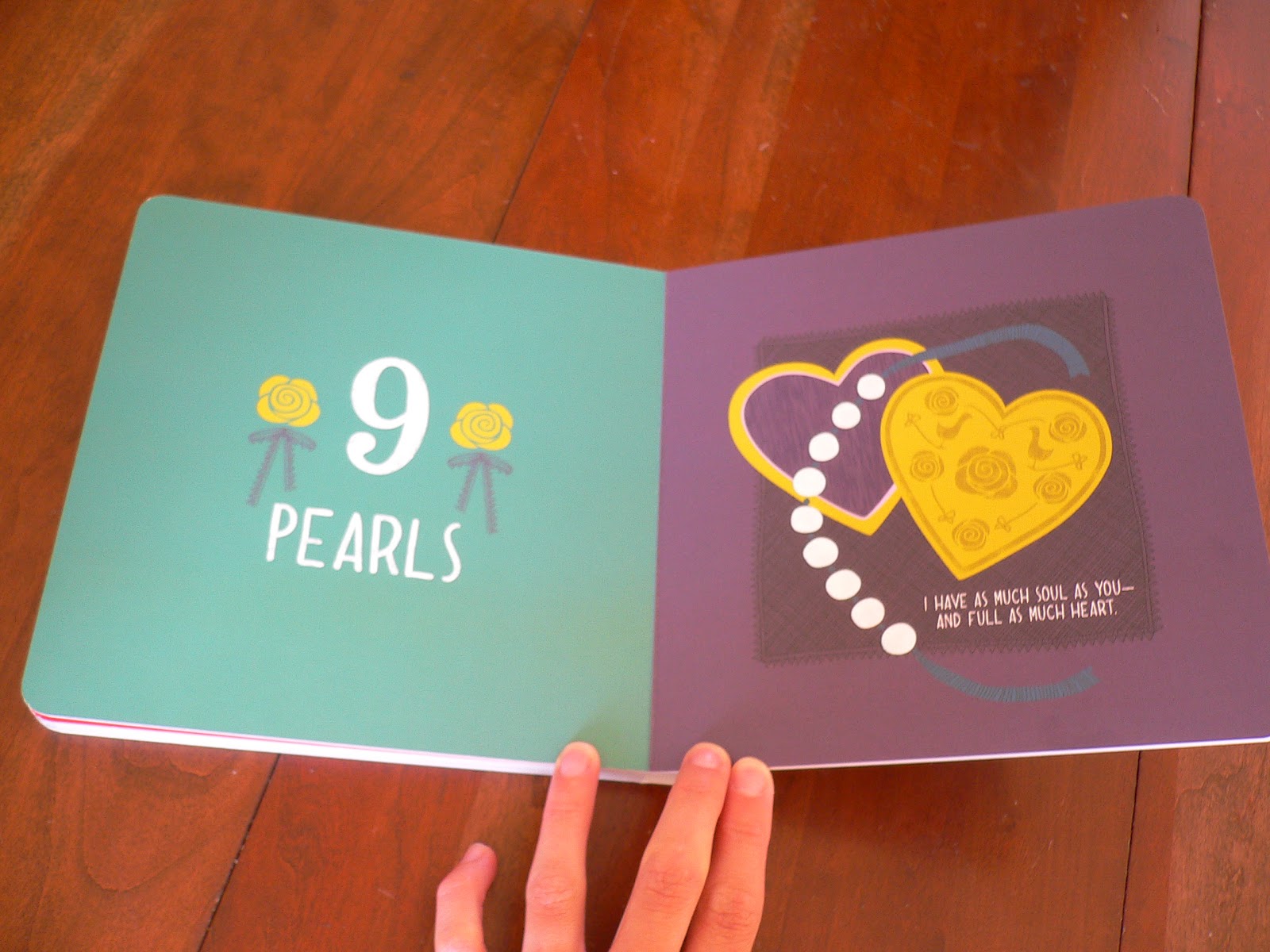
When Little Miss Bronte: Jane Eyre and Little Master Carroll: Alice in Wonderland first arrived on my doorstep I admit to squealing a bit. Because seriously, these books are utterly brilliant! Rich, vibrant colors and intricate, textured illustrations all but shout out 'Read Me!' Which I did. Several times. And
maybe I read them to my kids too. Once or twice. Although I confess that they currently live on my bookshelf and not theirs. To be fair however, as I write this review my four year old has wandered over to read the books to himself and is currently laughing himself silly over Alice in Wonderland. 

Thankfully, it seems that both the author and illustrator actually
know these classic stories -- there are subtle quotes and pictorial references to some of my favorite scenes from the books. Like this one from Jane Eyre, which references what is probably my most favorite quote ever. Plus the pearls!
 Or this one:
Which although the picture looks quite cheery, the text is suitably foreshadowing. Love. 

Upon further research it looks like there are several other ones including a Pride & Prejudice and a Romeo + Juliet story. Which both look so stinkin' adorable that I just might have to pick up those as well.  If you are looking for a unique baby shower or birthday gift you really couldn't go wrong with these two perfect little board books. They would also make excellent gifts to any bibliophile. Especially one of the Jane Eyre disposition. 

book source: provided by the publisher

The 10 Essential Classics

Classics are often a classic for a reason. But what are the top classics for YOU? Penguin wants to know. After compiling a list of the top ten Classics every person should read, they're now asking their readers to submit their own Top 10 favorites. But really Penguin...we can only choose 10?
Last year, we compiled a list of the top ten essential Penguin Classics every person should read.

We thought our list was complete.

We were wrong.


You wrote in about the books we left off our list. Where was War and Peace? Don Quixote? On the Road?

So we're creating a new list edited by you. What are your ten essential Penguin Classics?

Vote
and then enter for a chance to win a Penguin Classics gift bag with an assortment of Deluxe Penguin Classics (official rules below) on the Essential Classics REDUX Survey.

What are you waiting for? Go forth and vote!

Classic Literary Love: Jane & Rochester

Let's talk classic, classic literary couples for a moment here shall we? That's right. I'm talking Jane. Jane Eyre. Jane Eyre and Edward Fairfax Rochester to be exact. Reading this book never fails to leave me utterly spellbound. What more could you possibly want from a Charlotte Bronte Gothic Romance? A downtrodden, plucky yet pure governess meets a wealthy, wastrel aristocrat with the requisite mad wife hidden in the attic. It's got amnesia, ghosts, missing heiresses, witty conversation, and more angst than you can shake a stick at. Grab a chair and watch the sparks fly.Perhaps what makes Jane and Rochester so unforgettable is that they have to work ever so hard to have their happily ever after even though they see each other as their true home almost immediately. They have to surmount differences in class, in age, in *cough*experience*cough*, and they have to overcome that tiny detail that Rochester is already married and that Jane is his employee when they first meet. But they don't give up. Rochester continually prods her with his electric wit and charm while Jane staunchly resists even as she begins to find herself unfolding into this forthright and passionate creature before their very eyes. Take this outburst for example. Jane believes Rochester is going to be marrying the local, vapid beauty and finally gives in to her despair at his seeming indifference.
"Do you think I am an automaton? — a machine without feelings? and can bear to have my morsel of bread snatched from my lips, and my drop of living water dashed from my cup? Do you think, because I am poor, obscure, plain, and little, I am soulless and heartless? You think wrong! — I have as much soul as you — and full as much heart! And if God had gifted me with some beauty and much wealth, I should have made it as hard for you to leave me, as it is now for me to leave you. I am not talking to you now through the medium of custom, conventionalities, nor even of mortal flesh: it is my spirit that addresses your spirit; just as if both had passed through the grave, and we stood at God's feet, equal — as we are!"
Of course, Rochester then makes Jane understand just how much he truly loves her and a multitude of stolen kisses and a proposal follow. Even though Rochester set out trying to bring the isolated and unloved Jane out of her shell, I think maybe she ends up surprising him with her quick rejoinders just a little.
"I am not an angel," I asserted; "and I will not be one till I die: I will be myself. Mr. Rochester, you must neither expect nor exact anything celestial of me - for you will not get it, any more than I shall get it of you: which I do not at all anticipate."
Ha! I truly love these two. She's not letting him get away with anything and that's why Jane and Rochester must be listed as one of my favorite Literary Love couples.

And even though the Hubby calls her 'duck-lips' I absolutely adore the recent Masterpiece adaptation. I highly recommend you give this swoon-worthy miniseries a go if only for the perfect characterization of Rochester.

Who is your favorite Classic literature duo? Nominate your favorite Literary Love couple here or in the comments.

Lit 101: The Woman in White by Wilkie Collins

Lit 101 is a monthly feature of See Michelle Read wherein I'll spotlight and review at least one book considered to be 'classic literature' each month. These books will be the ones everyone should probably read at least once in their lifetime and namely the ones that I've personally never gotten around to reading and wish I had.

I'm not a huge mystery reader, but when I do sit down to a who-dunnit, I like my time period to be Victorian, my heroes to be relentless, and my villains to be seemingly unstoppable (care for a Lady Julia Grey mystery anyone?). When hearing that Wilkie Collins' most popular novel The Woman in White basically pioneered this genre, I knew it was one to go to the top of my TBR list and after reading it, I can only kick myself for not coming across it's brilliance previously.
This is the story of what a Woman's patience can endure, and of what a Man's resolution can achieve.
Thus begins the narrative of Walter Hartright.

As Walter is walking home late one evening he comes across a mysterious woman, dressed head to foot in white garments, in desperate need of aid. Walter helps her willingly (ever the gentleman) even though he is plagued by strange impressions of the woman as he continues on his way as he is expected to leave the next day to for his new job as drawing master for two young ladies in the country, Miss Laura Fairlie and her half-sister Miss Marian Halcombe. Even though Laura and Marian are as close as two sisters could possibly be, they are distinctly different: Marian is dark and unattractive and very, very smart while Laura is blond, delicate and extremely beautiful. So guess which sister Walter falls in love with? Of course, he is smitten from the first with Laura but behaves like a gentleman at all times (naturally). Once Marian learns that Laura returns his affection, she feels bound to reveal that Laura has already been promised to another man, Sir Percival Gylde, upon which, Walter leaves heartbroken for an extended journey in Central America.

Enter Sir Percival: he's the man Laura's dead father wished her to marry and has been nothing but proper but is now hoping to finally set a date to their marriage. Even though Laura is still heartbroken over Walter's departure, she agrees and the couple is soon married and leaves on their honeymoon to Italy before Marian knows what to think. But when the couple returns, Marian finds Sir Percival to be very different from the man he previously appeared to be - brutish and almost cruel to Laura. Sir Percival has also returned with his good friend Count Fosco and his devoted wife, who happens to be Laura's estranged aunt. It quickly becomes obvious that Sir Percival is experiencing extreme financial difficulties and that the oddly charming yet disturbing Count Fosco has some sort of manipulative sway over the man. Together, they have planned one of the most audacious, most brilliant crimes involving Laura, Marian and even the illusive woman in white encountered by Walter so many months before. Laura and Marian quickly discover that Sir Percival and Fosco will stop at nothing to get what they want and that they have no one to trust but each other and the resourceful Walter Hartright - who is determined to see justice done.

Published in 1860, The Woman in White is said to be one of the first mystery novels ever written in the Gothic style - it's success primarily due to having a likable amateur detective as hero, Walter Hartright, matched with a highly unorthodox villain, Count Fosco. Lies, surprising secrets revealed, amnesia, intrigue, and manipulation all combine to make this an engrossing read. Written in a modified epistolary form from the perspective of multiple characters, I wasn't sure I would enjoy a novel written by several different narrators but each separate account combined to create a chilling story where the puzzle pieces slowly fall into perfect place. Each voice was distinct and unique - from Marian's forthright and intelligent account to Mr. Fairlie's openly condescending (yet often hilarious) impressions as the family invalid.

I've alluded to this already, but the best part about this novel has to be the characters - and I'm not just talking about Walter and Laura (boo! no one likes a pretty doormat!). On no, there is a full and distinct complement of secondary characters who give background, realism and strength to the story. Let's go over a few of my favorites, shall we?

1. Two words: COUNT FOSCO. Count Fosco is everything you could ever want in a villain - the man is creepy, totally smart, can be utterly charming when he needs to be. Perhaps the greatest point in his favor is that he saw past Marian's ugliness and fell in love with her for her MIND unlike everyone else who trailed after the spineless Laura. Add in that the man has confidence in spades, and you've got yourself a winner.

2. Marian Halcombe is the ugly, poor half-sister to the lovely Laura but without her, Laura would have never achieved any sort of future or happiness. With limited resources she gets the job done, understands the meaning of subtly and has the memory of an elephant.

3. Lastly, in the time-honored tradition of Victorian literature Wilkie Collins presents us with a masterpiece of an invalid in Mr. Frederick Fairlie. Acting as Laura's guardian, he's selfish, despotic and has some of the best lines in the entire novel - usually when he wants people to leave him alone and so begins to wax poetic about some random subject or other. For example, here he is trying to understand why a woman would cry when she is upset:
I distinctly object to tears. Tears are scientifically described as a Secretion. I can understand that a secretion may be healthy or unhealthy, but I cannot see the interest of a secretion from a sentimental point of view.
The Woman in White may be full of Victorian language and legal descriptions but it quietly builds into a world class thriller, which left me clutching the book, dying to find out what would happen next. Each storyline is carefully planned out with each individual thread crossing and connecting in multiple directions - it's obvious Wilkie Collins was a master craftsman in his genre. Such storytelling, with some unforgettable characters, I was totally hooked.

Yeah, but is it a classic? Yes!! I'll make room for it on the shelf for good.

What about you? Have you read it? I'd love to hear your reaction.

Because Everyone Likes a Second Opinion:
Books Bytes review
Jandy's Reading Room review
Musings of a Bookish Kitty review
Reading, Writing and Retirement review

December Lit 101 feature: The Awakening by Kate Chopin

book source: purchased

Introduction to...


I'm coming up on my 100th blog post (yipee!) and it really got me to thinking about what I want to accomplish with this here blog thingy. After much thought and massive consumption of salty snacks, I've decided that in order to help me accomplish one of my reading goals, I'm going to start a new feature called Lit 101 - wherein I'll spotlight and review at least one book considered to be 'classic literature' each month. These books will be the ones everyone should probably read at least once in their lifetime and namely the ones that I've personally never gotten around to reading and wish I had.

I'd love for others to join me in my classics adventure - feel free to pick up the ones I've got planned or choose another great work you've never read but have always wanted to settle into. Here's the books I've got scheduled for the next couple of months:

November ~ Woman in White by Wilkie Collins
December ~ The Awakening by Kate Chopin
January ~ Corelli's Mandolin by Louis de Bernieres

I'm competely, totally open to suggestions!!

And just to get the 'ole juices flowing, here's a couple of lists naming some of the greatest books ever written: BBC Big Read, Newsweek's Top 100 Books, College Bound 101 Books

A Room With a View by E. M. Forester

There's not much I can't say about this wonderful book that hasn't already been said by others much more eloquently and comprehensively.

So I'm not going to say much.

Well, not that much. I like to talk about books too much not to say anything. Forester's timely classic centers around a young girl, Lucy Honeychurch, who takes a trip to Italy with her spinster cousin, Charlotte, and there meets some other English travelers including Mr. George Emerson. Lucy is young, impressionable and used to being told what to think and what to do. However, while in Italy, she and George witnesses a murder (a dispute over 5 francs!) and she begins to slowly understand that life is more than just doing and feeling the things society says you should. George, I think, sees this potential for true emotion in Lucy. He himself is on the brink of some sort of change and sees Lucy a woman who can understand the complicated emotions he is experiencing. But Lucy is scared, she doesn't quite want to leave her safe world behind and so leaves Florence and her unsettling encounter with George. Upon returning to England, her trip seemingly behind her, Lucy accepts the proposal of one Cecil Vyse, a young man who she also spent time with in Rome. No one really likes Cecil and for all his professed modernism and intellectualism, he really just wants to keep Lucy on a pedestal. Thankfully, she finally wises up after another unsettling enounter with George Emerson in which she finally makes choices for herself and no one else.

All this happens with such subtle humor and wit. Forester is a master at understatement and descriptiveness at the same time. He paints the scenes of historic Florence with as much precision and beauty as he does Lucy's country home in England. I want to ramble through the woods at her house and see the church and pond. He makes it all come alive and it's beautiful. And the names in this book, they are undeniably English! Lucy Honeychurch, Windy Corner, Cecil Vyse - I mean, doesn't he just sound like a wimp? What's more is Lucy's transformation into a woman who can take charge of her own life and decides what she wants - even when those around her my be hurt by her choice. A beautiful book with so much insight and wit. I loved it.

Summer Reading Blitz update: 8/10

Teaser Thursday


I'm in the middle of A Room with a View (fantastic!) and thought I'd share a couple of highlights. Both these passages center around Lucy, who in the first doesn't know really what she wants but does without a doubt in the second. Enjoy!

"My dear," said the old man gently, "I think that you are repeating what you have heard older people say. You are pretending to be touchy; but you are not really. Stop being so tiresome, and tell me instead what part of the church you want to see. To take you to it will be a real pleasure."
Now this was abominably impertinent, and she ought to have been furious. But it is sometimes as difficult to lose one's temper as it is difficult at other times to keep it. p.24

"I won't be protected. I will choose for myself what is ladylike and right. To shield me is an insult. Can't I be trusted to face the truth but I must get it second-hand through you?" p.187

Wuthering Heights by Emily Bronte


Supposedly one of the 'great' love stories of all time, I have always felt Catherine and Heathcliff's relationship was selfish, manipulative and just plain weird. I could never understand why she felt she could marry Linton and still have Heathcliff on the side and that Edgar would accept him too. I guess she could see herself aiding Heathcliff in the process, but I just can't see how she could rationalize that. Maybe it is just a bitter reminder of how stringent class distinctions were in that period.

For the longest time I felt nothing but disgust for Heathcliff until after thinking about this book for some time: he may be vindictive, mean spirited and low but he did have a rough life where he was mistreated at every turn. I think his one redeeming moment was when Cathy and Hareton were starting to connect and he couldn't bear to punish them -- perhaps he did have a heart if only it lay beneath layers and layers of darkness. This time around I actually felt like Catherine was more the villain than he ever was.

I'm glad I reread this one from an adult standpoint. I know that love isn't always passionately destructive and all consuming -- but 'Wuthering Heights' truly is an engrossing tale.

I highly recommend the recent Masterpiece adaptation, it was fantastic!